Title here
Summary here
Partitioning (also called sharding in databases or topic partitioning in message brokers) is the art of splitting a large dataset or stream into disjoint slices so reads, writes, and storage scale horizontally across many machines.
While Sharding & Replication explains why you split vs. copy data, this guide goes deeper into how to pick the right partitioning strategy, avoid skewed hot partitions, and rebalance partitions safely as your cluster grows.
Your choice of partitioning strategy is a direct trade-off between fast range queries and even write distribution:
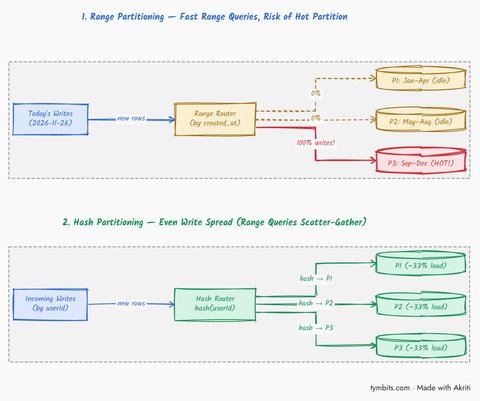
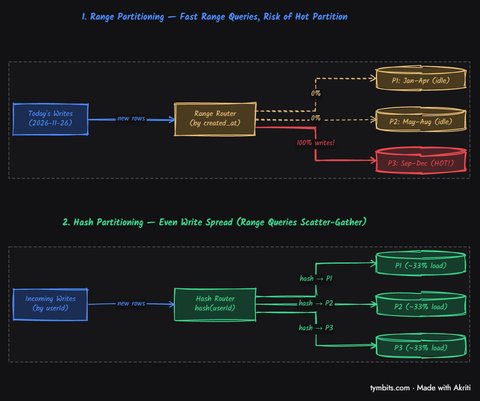
Assigns each partition a continuous range of keys (like A–M, N–Z, or monthly date ranges Jan–Apr, May–Aug, Sep–Dec). Keys inside each partition stay sorted.
WHERE created_at BETWEEN '2026-11-01' AND '2026-11-26') hit a single partition cleanly.Passes the partition key through a fast, deterministic hash function (like MurmurHash3 or MD5) and maps the hash onto a partition — typically via consistent hashing or fixed virtual buckets.
user_101, user_102, user_103) land on completely different shards, eliminating sequential write hotspots.Systems like Apache Cassandra and Amazon DynamoDB use a two-part key: (partition_key, sort_key) — for example (user_id, created_at):
user_id) is hashed to spread users evenly across the cluster.created_at, so fetching a user’s last 50 orders is a single fast sequential slice on one shard!| Strategy | Point Lookups | Range Queries | Write Balance | Best Use Case |
|---|---|---|---|---|
| Range | Single partition | Single partition (fast!) | Poor on sequential keys | Time-series archives, ordered lexicons |
| Hash | Single partition | Scatter-gather (all shards) | Excellent across random keys | User profiles, sessions, key-value caches |
Composite (hash, sort) |
Single partition | Fast within one partition key | Excellent (unless one key is a celebrity) | Chat timelines, user activity feeds, IoT sensors |
| List / Geo | Single partition | Per-region | Depends on regional traffic | Data residency (region = EU, US, IN) |
Even with hash partitioning, if one celebrity account (user_id = 1) or viral flash-sale product receives 40% of all traffic, all of that traffic hashes to the exact same partition and melts that single machine.
Three proven fixes:
0..9 to hot keys on write (celebrity_1#0 … celebrity_1#9) so writes spread across 10 partitions. Reads merge results from all 10 salted keys (only apply salting to known hot keys, not normal users!).Never use naive hash(key) % numNodes — adding one node reshuffles almost everything. Production databases use one of three rebalancing models:
1,024 logical partitions across 8 servers = 128 per server). When you add a 9th server, it steals ~114 whole logical partitions from existing nodes — no key re-hashing required! Used by Elasticsearch, Redis Cluster (16,384 hash slots), and Riak.10 GB), the cluster automatically splits it in half (P1 → P1a + P1b) and moves one half to a less-loaded node. Used by HBase, CockroachDB, and MongoDB.100–200 virtual tokens per machine around a consistent hash ring so new machines smoothly absorb proportional arcs. Used by Cassandra and DynamoDB.WHERE clauses for 90%+ of your hottest queries).hash(orderId) % numPartitions) so all events for the same order land in the same partition (preserving strict per-order ordering), while spreading total throughput across brokers and consumers.