Title here
Summary here
In a cloud or container environment (Kubernetes, AWS ECS, autoscaling VMs), service instances spin up, crash, redeploy, and get brand-new ephemeral IP addresses every few minutes. Hardcoding IPs in config files breaks immediately. Service discovery solves this by maintaining a live directory — a service registry — of every healthy service instance and its current IP:port, so callers can locate dependencies by logical name (like payment-service) instead of static addresses.
There are two primary ways a caller (Order Service) finds and talks to a healthy instance of Payment Service:
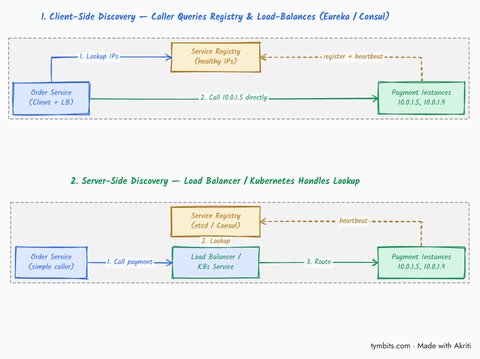
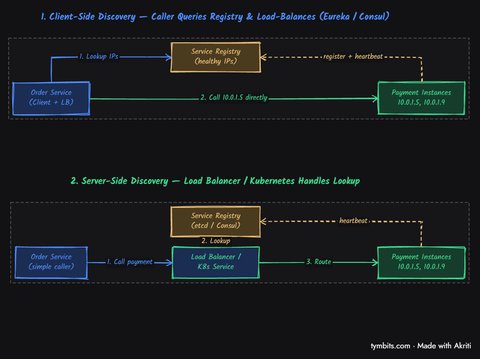
The calling service embeds a discovery SDK (e.g., Netflix Eureka client, Consul SDK, or a gRPC resolver). It queries the Service Registry, caches the list of healthy Payment IPs locally, picks one using a client-side load-balancing algorithm (round robin, least latency), and calls that IP directly.
The calling service stays completely dumb — it simply sends requests to a stable virtual address (a Kubernetes Service DNS name, an internal Load Balancer, or a service mesh sidecar like Envoy/Istio). That router queries the registry (etcd, Consul, AWS Cloud Map) and forwards traffic to a healthy instance.
iptables/eBPF like Kubernetes kube-proxy or Cilium) and makes the router itself a critical component.| Dimension | Client-Side Discovery | Server-Side Discovery |
|---|---|---|
| Who queries the registry? | Calling service (via SDK) | Load balancer, K8s kube-proxy, or sidecar proxy |
| Extra network hop | None (direct caller → target) | 1 hop (or local kernel/sidecar hop) |
| Polyglot language support | Harder — needs SDK in every language | Effortless — plain DNS / HTTP works everywhere |
| Examples | Netflix Eureka + Spring Cloud, gRPC custom resolver | Kubernetes Services (CoreDNS + etcd), AWS ALB / Cloud Map, Consul + Envoy |
A service registry is only useful if dead instances disappear fast:
every 5–10s) to renew its lease, or the registry actively probes /healthz (readiness probe). If heartbeats stop, the registry evicts the IP so traffic stops flowing to the dead container.Because the service registry is itself a distributed system, it must make a CAP theorem choice during network partitions:
etcd, Apache ZooKeeper, Consul): Powered by Raft consensus. Guarantees every node sees a consistent view of registered services, at the cost of rejecting new registrations on the minority side of a network split.etcd → kube-proxy/Envoy) to avoid stale DNS caches.Service, the control plane assigns it a stable virtual IP (ClusterIP) and registers its DNS name in CoreDNS (e.g., payment.prod.svc.cluster.local). As pods pass readiness probes, Kubernetes updates EndpointSlices stored in etcd, and kube-proxy (or Cilium eBPF) on every node routes packets directly to healthy pod IPs./orders/*). Service discovery operates internally (east-west and behind the gateway) to tell both the gateway and microservices which dynamic IP addresses are currently healthy for a given service name.