Title here
Summary here
A rate limiter controls how many requests a client, user, IP address, or API key can send to a service within a given time window (for example, 100 requests per minute). When a caller exceeds its quota, the rate limiter rejects excess requests early — usually with HTTP 429 Too Many Requests — protecting backend servers, databases, and third-party APIs from overload, abuse, and runaway retry storms.
Rate limiting is typically enforced at the edge inside an API Gateway, CDN, or reverse proxy before requests ever touch application servers.
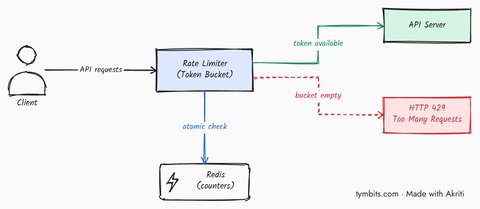
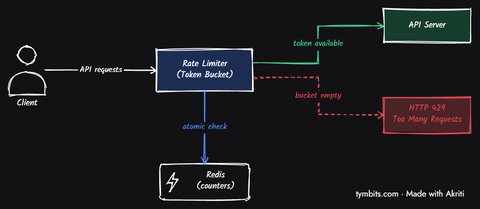
When a request arrives, the limiter extracts a key (such as userId, apiKey, or client IP), atomically checks and updates that key’s counter in a fast in-memory store like Redis (see Caching), and either forwards the request or returns 429 with helpful response headers:
X-RateLimit-Limit — total requests allowed per windowX-RateLimit-Remaining — requests left in the current windowRetry-After — seconds the client should wait before retryingEach algorithm trades off burst tolerance, memory usage, and boundary accuracy:
| Algorithm | How It Works | Burst Handling | Memory per Key | Best For |
|---|---|---|---|---|
| Token Bucket | Bucket refills at a steady rate up to a max capacity; each request takes 1 token | Allows short bursts up to bucket size | Low (2 numbers: tokens + timestamp) | General APIs (Stripe, AWS, Envoy default) |
| Leaky Bucket | Requests enter a fixed-size queue and drain at a constant output rate | Smooths out bursts completely | Low–Medium (queue depth) | Protecting downstream systems that need strictly steady traffic |
| Fixed Window Counter | Increments a counter per fixed slot (e.g., 12:01:00–12:01:59) |
Can allow 2× burst across a window boundary | Lowest (1 integer) | Simple coarse quotas where edge spikes are acceptable |
| Sliding Window Log | Stores timestamps of every request in the last T seconds (e.g., Redis Sorted Set) |
Strictly accurate — no boundary spikes | High (stores every timestamp) | Low-volume, strict security endpoints (login, OTP) |
| Sliding Window Counter | Weighted average of the previous and current fixed window counters | Very accurate with almost no edge spike | Lowest (2 integers) | High-throughput APIs needing accuracy + tiny memory |
Running a rate limiter on one server is trivial. Running it across a fleet of stateless gateways behind a load balancer introduces two classic problems:
remaining = 1 from Redis at the exact same millisecond, both may allow the request. Solve this using Redis Lua scripts (which execute atomically on a single thread) or atomic INCR + EXPIRE commands.429 Too Many Requests along with a Retry-After header so well-behaved clients back off cleanly instead of retrying immediately in a tight loop.429 is usually better than holding connections open. For background jobs or webhooks, you can buffer excess work into an asynchronous messaging queue so consumers drain it at a steady pace.