Title here
Summary here
Consistent hashing is a technique for distributing keys across a pool of servers so that adding or removing a server only remaps a tiny fraction of keys (~K / N on average) instead of reshuffling nearly the entire dataset. It is the backbone of distributed caching, sharded databases, and sticky load balancers.
hash(key) % N) Fails The simplest way to pick a server from N nodes is serverIndex = hash(key) % N. That works fine while N never changes — and breaks catastrophically the moment a server crashes or you scale out:
N = 4 cache nodes and 1 node goes down (N = 3).4 to 3, almost every key hashes to a different remainder (~75% of keys remap, and with 100 nodes, ~99% remap!).Consistent hashing decouples key placement from the total node count N by mapping both servers and keys onto the same fixed circular hash space (shown below as 0..359 for clarity; in production, typically 0 to 2^32 - 1):
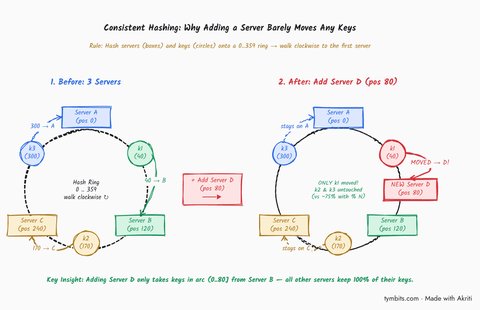
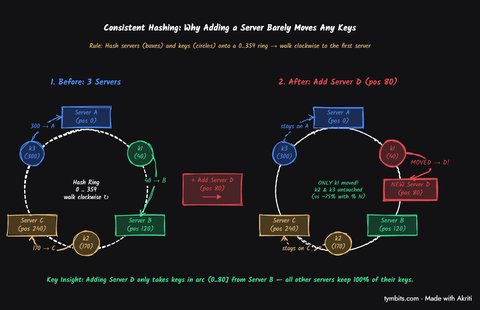
Server A (0), Server B (120), and Server C (240).k1 (40), k2 (170), and k3 (300).k1 (40) → Server B (120)k2 (170) → Server C (240)k3 (300) → wraps past 359 → 0 to Server A (0)Now look at the After panel when the cluster changes:
Server D at position 80: Only keys falling in the arc (0..80] — here just k1 (40) — move from Server B to Server D. Both k2 (170) and k3 (300) keep their exact same owners (Server C and Server A), whereas hash(key) % N would have reshuffled ~75% of all keys.Server B crashes): Only Server B’s keys shift clockwise to Server C. All other nodes keep 100% of their keys.With only a few physical nodes on a ring, random hashing often creates lopsided arcs — one node might end up owning 60% of the ring while another owns 10%. And if one node fails, its single clockwise neighbor suddenly absorbs 100% of its traffic.
Virtual nodes (vnodes) fix both issues:
Node A once on the ring, place 100–200 virtual replicas (Node A#1, Node A#2, …, Node A#150) scattered randomly around the circle.| Dimension | Naive Modulo (hash % N) |
Consistent Hashing (with Vnodes) |
|---|---|---|
| Keys moved when adding/removing 1 node | ~((N - 1) / N) (nearly 100% at scale) |
~1 / N (theoretical minimum) |
| Lookup complexity | O(1) |
O(log(N × V)) via binary search on sorted ring |
| Heterogeneous hardware support | Hard | Easy — assign more virtual nodes to larger servers |
| Cache miss storm on node failure | Severe | Minimal — only failed node’s slice remaps |
hashPosition → nodeId. To look up a key, compute h = hash(key) (e.g., MurmurHash3 or xxHash), binary-search for the first position >= h, and wrap around to index 0 if h is larger than the last node on the ring.R = 3 replicas of a key, walk clockwise from hash(key) and pick the first 3 distinct physical nodes (skipping duplicate virtual nodes belonging to the same physical machine).