Title here
Summary here
Distributed consensus is the problem of getting multiple independent servers to agree on a single sequence of values or state — even when machines crash, restart, or suffer network delays and partitions. Consensus is the engine powering leader election, distributed locks, configuration stores (etcd in Kubernetes, Consul), and strongly consistent databases (CockroachDB, TiKV, Cockroach, Kafka KRaft).
Because Paxos was notoriously difficult to understand and implement cleanly, Diego Ongaro and John Ousterhout designed Raft (2014) to provide the exact same fault-tolerance guarantees while decomposing consensus into two understandable parts: Leader Election and Log Replication.
Every node in a Raft cluster is in one of three states: Leader (handles all client writes and sends heartbeats), Follower (passive replica that obeys the leader), or Candidate (a follower requesting votes after the leader goes silent). Time is divided into monotonically increasing Terms (logical election epochs).
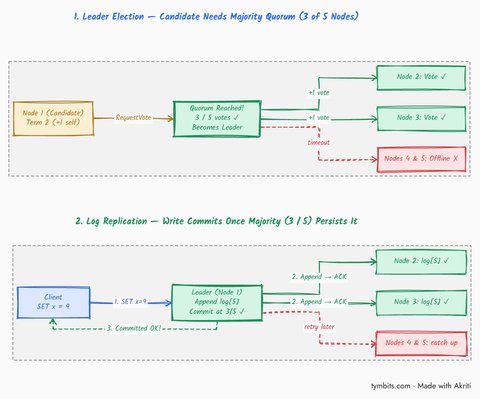
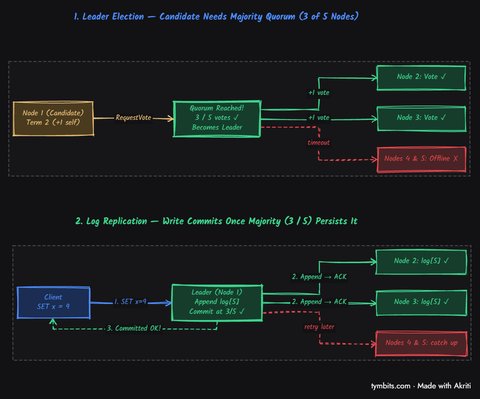
AppendEntries heartbeats (every ~50–150ms) to all followers. If a follower receives nothing within its randomized election timeout (150–300ms), it assumes the leader crashed.Term (e.g., Term 1 → Term 2), votes for itself, becomes a Candidate, and broadcasts RequestVote RPCs to every peer.N / 2 + 1): Each node grants at most one vote per term (and only if the candidate’s log is at least as up-to-date as its own). In a 5-node cluster, collecting 3 votes elects the new Leader immediately — even if 2 nodes are dead!SET x = 9. The Leader appends the entry to its local write-ahead log (log[5], uncommitted).AppendEntries(log[5]) to all followers in parallel.3 of 5: Leader + 2 followers) confirms the entry is durably written to disk, the Leader marks log[5] committed, applies x = 9 to its state machine, and returns OK to the client.Nodes 4 & 5) automatically receive missed log entries once they reconnect — Raft’s log-matching check guarantees every node eventually holds the exact same log in the exact same order.Suppose a network partition splits a 5-node cluster into {N1, N2} (2 nodes) and {N3, N4, N5} (3 nodes):
N-node cluster must overlap by at least one node.{N3, N4, N5} has a quorum (3/5), so it can elect a new leader and keep accepting writes.{N1, N2} only has 2/5 — it cannot win an election or commit new writes! Even if N1 used to be the old leader, its writes stall because it cannot get 3 ACKs, completely preventing split-brain (two leaders accepting conflicting writes).Cluster Size (N) |
Quorum Needed | Failures Tolerated | Recommendation |
|---|---|---|---|
| 3 nodes | 2 | 1 node | Smallest production HA cluster (survives 1 crash or planned reboot) |
| 4 nodes | 3 | 1 node | Avoid! Same fault tolerance as 3 nodes, higher latency and bigger quorum |
| 5 nodes | 3 | 2 nodes | Standard production sweet spot (survives 1 planned maintenance + 1 unexpected crash) |
| 7 nodes | 4 | 3 nodes | Large multi-AZ control planes; beyond 7, replication fan-out slows writes |
etcd, CockroachDB, TiKV, Consul, Kafka KRaft): Strong leader, contiguous log replication, explicit randomized election timeouts — designed for understandability and clean production engineering.51 nodes out of 100!), which destroys throughput and latency. Instead, distributed SQL databases like CockroachDB and Google Spanner split data into thousands of small shards (see Partitioning Strategies), and each shard runs its own tiny 3-node or 5-node Raft group (Multi-Raft).3f + 1 nodes and far more messaging overhead.etcd, a distributed key-value store powered directly by Raft.