Title here
Summary here
Inside a single relational database, an ACID transaction (BEGIN ... COMMIT / ROLLBACK) makes multi-row updates all-or-nothing effortlessly. The moment a business workflow spans multiple microservices (Order DB + Payment DB + Inventory DB) or multiple database shards, there is no single local lock manager anymore — if Step 2 succeeds and Step 3 crashes, your system is left half-updated.
A distributed transaction coordinates state changes across independent data stores so they either all succeed or cleanly roll back. In practice, engineers choose between two fundamentally different approaches: Two-Phase Commit (2PC) or the Saga Pattern.
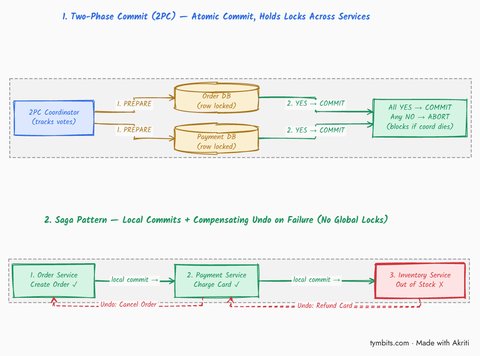
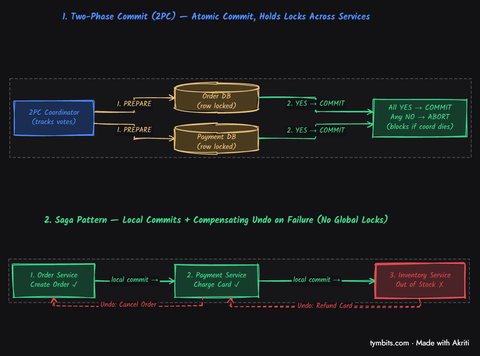
A central Coordinator runs two rounds across all participating databases:
Order DB, Payment DB): “Can you guarantee this commit?” Each DB acquires row locks, writes to its WAL, and replies YES (or NO).YES, the coordinator logs COMMIT and tells everyone to commit and release locks. If any voted NO (or timed out), it tells everyone to ABORT.Why microservices rarely use 2PC across service boundaries:
YES and before Phase 2 arrives, every participant must hold row locks indefinitely until the coordinator recovers — freezing unrelated traffic!(Note: 2PC IS widely used internally inside distributed SQL databases like Google Spanner and CockroachDB — where the coordinator is itself replicated via Raft consensus so it never permanently crashes!)
Instead of one giant locked transaction, a Saga breaks the workflow into a sequence of independent local transactions (T1 → T2 → T3), each committing immediately in its own database and triggering the next step via a message broker:
Create Order ✓ → Charge Card ✓ → Reserve Stock ✓.Reserve Stock fails (Out of Stock ✗), the Saga runs compensating transactions in reverse order (Refund Card → Cancel Order) to semantically undo the prior committed steps!| Dimension | Two-Phase Commit (2PC) | Saga Pattern |
|---|---|---|
| Consistency model | Strong ACID (atomic & isolated) | Eventual consistency (ACD — no isolation between steps) |
| Locking | Holds locks across nodes during network RTT | Local locks only (sub-millisecond) |
| Availability under failure | Blocks if coordinator dies mid-commit | Non-blocking — retries and compensates asynchronously |
| Works with external APIs? | No (requires XA-compliant stores) | Yes (works with Stripe, email, webhooks, NoSQL) |
| Best fit | Distributed SQL internals (Spanner, CockroachDB) | Multi-service workflows (checkout, booking, fulfillment) |
There are two ways to wire the steps of a Saga:
OrderCreated, PaymentCharged, InventoryFailed) and listens for events it cares about. No central coordinator — great for simple 2–3 step flows, but hard to trace or change once 6+ services are chained together.ChargeCard, ReserveInventory) and drives retries and compensations from one readable state machine. Preferred for complex multi-step business workflows.db.commit() followed by kafka.publish() in two separate calls — a crash between them breaks the Saga. Write the outbound event into an outbox table inside the exact same local DB transaction and relay it reliably (see Temporal Coupling).ChargeCard(orderId=42) and RefundCard(orderId=42) must safely handle duplicate deliveries using idempotency keys.OrderCreated is committed before inventory is checked, a user might briefly see their order before it cancels. Use explicit intermediate states (PENDING → CONFIRMED / CANCELLED) — called semantic locking — so other services never ship an unconfirmed order!RefundCard or ReleaseStock) must never give up — they are retried with exponential backoff until they succeed (often paired with a Dead-Letter Queue and ops alerting for truly exceptional cases). Always design compensations to be idempotent and commute safely with retries.